
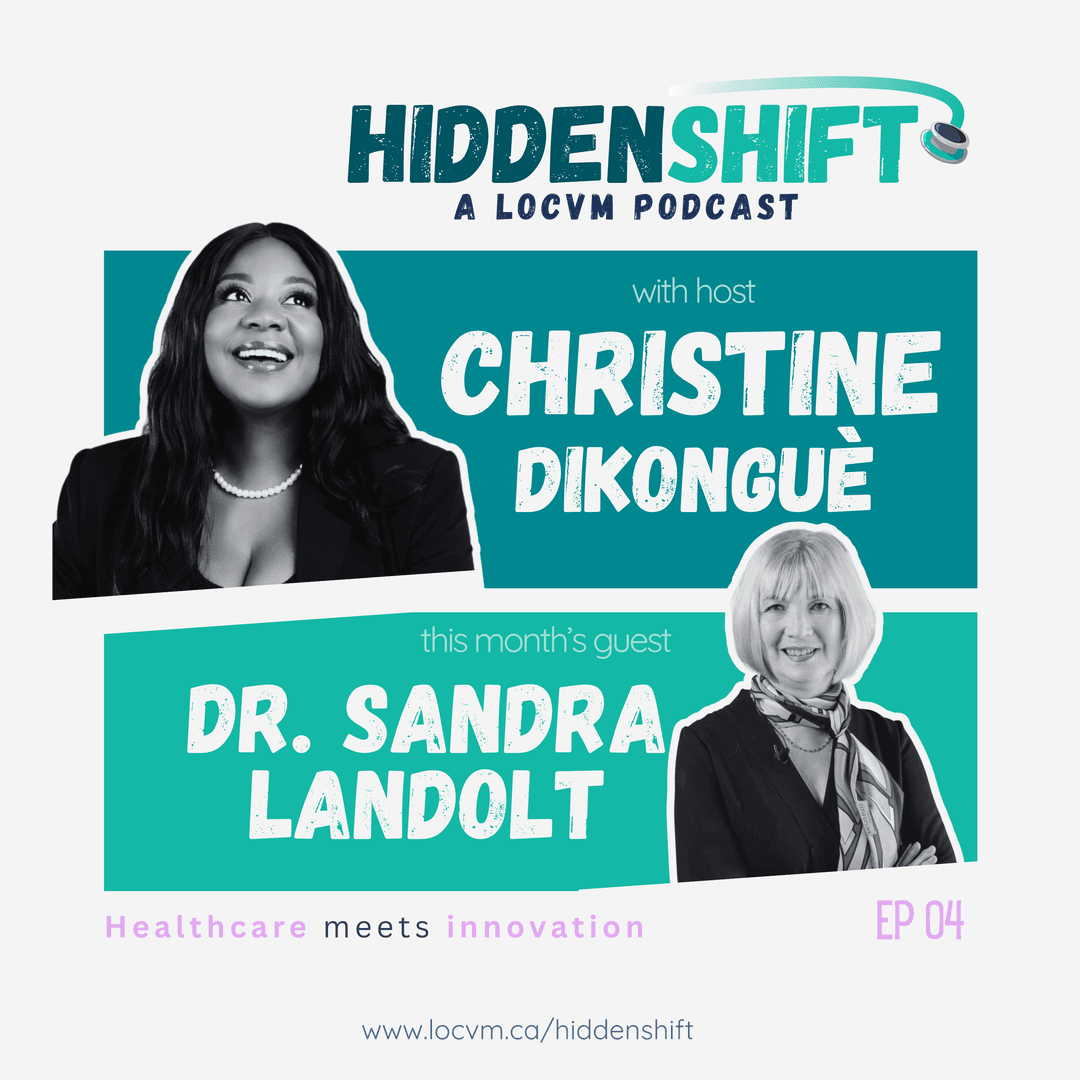
From Performance to Presence: What 33 Years in Medicine Teaches You About Yourself
A conversation with Dr. Sandra Landolt, dermatologist, social media voice, and proponent of what she calls "the silver effect", on professional identity, earned confidence, and what changes when you stop performing.
The long arc of becoming
Dr. Sandra Landolt has been practising dermatology for 33 years. She came to it after fellowships in both internal medicine and dermatology, a combination she describes as accidental and ultimately ideal - dermatology for the craft, internal medicine for the complexity of caring for people who are seriously unwell. Four generations of some families have been her patients. That kind of longitudinal care, she says on The Hidden Shift, is among the most gratifying things a physician's career can offer.
But the conversation isn't really about the clinical arc. It's about something harder to name - the internal shift that happens, if you're fortunate, somewhere in the middle or later years of a medical career, when performing the role of doctor and actually being a doctor begins to merge.
What the silver effect actually means
Dr. Landolt recently coined the term "the silver effect", inspired in part by her own decision to stop dyeing her hair and in part by a conversation with Dr. Martha Van Beek. A dermatologist, Mohs surgeon, and trustee of the American College of Medicine, Dr. Van Beek was speaking at a conference about burnout and resilience rather than dermatology.
Van Beek's central argument, which resonated with Dr. Landolt, was that framing physician distress as a deficit in resilience places the burden on individuals rather than on the system itself. But the insight Dr. Landolt carried away was quieter and more personal. Older people are, on average, innately happier, partly because they have moved out of the stage of performing and into what she calls presence.
“It's when you get to the point whereby you're no longer acting. It doesn't really matter to you what the person in front of you is thinking in their mind and saying about you. You just walk in there and you're you.”
This is not, she is careful to clarify, the same as not caring. It is more that the energy previously spent on appearance, including appearing authoritative, appearing experienced, appearing unrattled, becomes available for something else.
The specific weight of being a woman in medicine
Dr. Landolt is direct about the gendered dimension of the performing stage. Early in her career, she was young-looking, frequently mistaken for a student, and practising as a specialist to patients who were twenty years her senior and had expected someone who looked different. The work of establishing credibility with patients, with senior colleagues, with the institutional culture of medicine was real and ongoing.
“Physicians, especially women physicians, are often expected to behave in certain ways to be taken seriously. That hasn't fully changed.”
She recalled leading a meeting and being asked whether she was there to take notes - a small but familiar reminder that these assumptions persist, even when her role is unmistakably clear.
What changes, she says, is not the occurrence of these moments but the internal response to them. The confidence to hold a situation without needing to perform it. The ability to let the encounter be what it is without spending energy managing the perception.
On building a public platform - and why the boundary matters
Dr. Landolt came to Instagram not as a marketing exercise but as an extension of what she had already been doing informally: mentoring women physicians, providing reliable dermatology information, modelling a version of professional life that includes aging visibly and without apology. She chose Instagram, she explains, partly because of the boundary it provides - the screen between her and whoever is receiving the information. Facebook, she says, takes more from you; TikTok requires more of you. Instagram, at least in her use of it, allows her to put information out without absorbing the full weight of what comes back.
The audience she reaches is, she says, largely older women, including physicians at various stages of their careers, and the people those women care for. The platform is called The Silver Dermatologist; the clinical credibility and the personal voice exist alongside each other rather than in conflict.
What The Silver Dermatologist gets to say that Dr. Landolt in the exam room cannot, she reflects, is less than it used to be. "The doctor version of you is closer to the real you." The three versions of herself - the alter ego, the person, the doctor - have blended in a way that wouldn't have been possible, or perhaps safe, earlier in her career.
What this looks like in practice
The research literature on physician career development offers limited evidence on the specific experience Dr. Landolt describes. The transition from performance to presence remains understudied in the medical workforce literature. What the research does show, consistently, is that burnout is a structural phenomenon amplified by workload, administrative burden, and insufficient system support, and that individual wellness frameworks inadequately address structural drivers (Mathews et al., 2024).
What Dr. Landolt describes is not a wellness framework. It is something more like a natural adaptation, one that takes decades, is not universally available, and cannot be accelerated by a workshop. The question for the system is whether the conditions exist for physicians to reach that point without leaving medicine first.
For the physician reading this somewhere in the middle of a career: her message, offered to women scrolling Instagram and to residents she has mentored over decades, is the same. "You are enough." Simple, she acknowledges. But, she adds, it works.
Source
Dr. Sandra Landolt is a dermatologist with 33 years of practice experience and the creator of The Silver Dermatologist platform on Instagram. This article is based on her conversation with Christine Dikonguè for The Hidden Shift podcast.
References
Mathews M, Idrees S, Ryan D, et al. System-based interventions to address physician burnout: a qualitative study of Canadian family physicians' experiences during the COVID-19 pandemic. Int J Health Policy Manag. 2024;13:8166. doi:10.34172/ijhpm.8166