
What Physicians Lose Before and After the Clinical Day
A conversation with two physician-founders reveals how the invisible work of medicine is reshaping careers — and what a more functional system might look like.
Ask a Canadian family physician what their day looks like, and most will describe the part patients see: the appointments, the conversations, the clinical decisions. Ask them what their day actually looks like, and a different picture emerges.
"The work begins before you start seeing patients," says Dr. Joyce Chung, a family and palliative care physician in Toronto. "And once you're done your shift, you may have more paperwork to do — charting, refills, lab results, calling people for critical results."
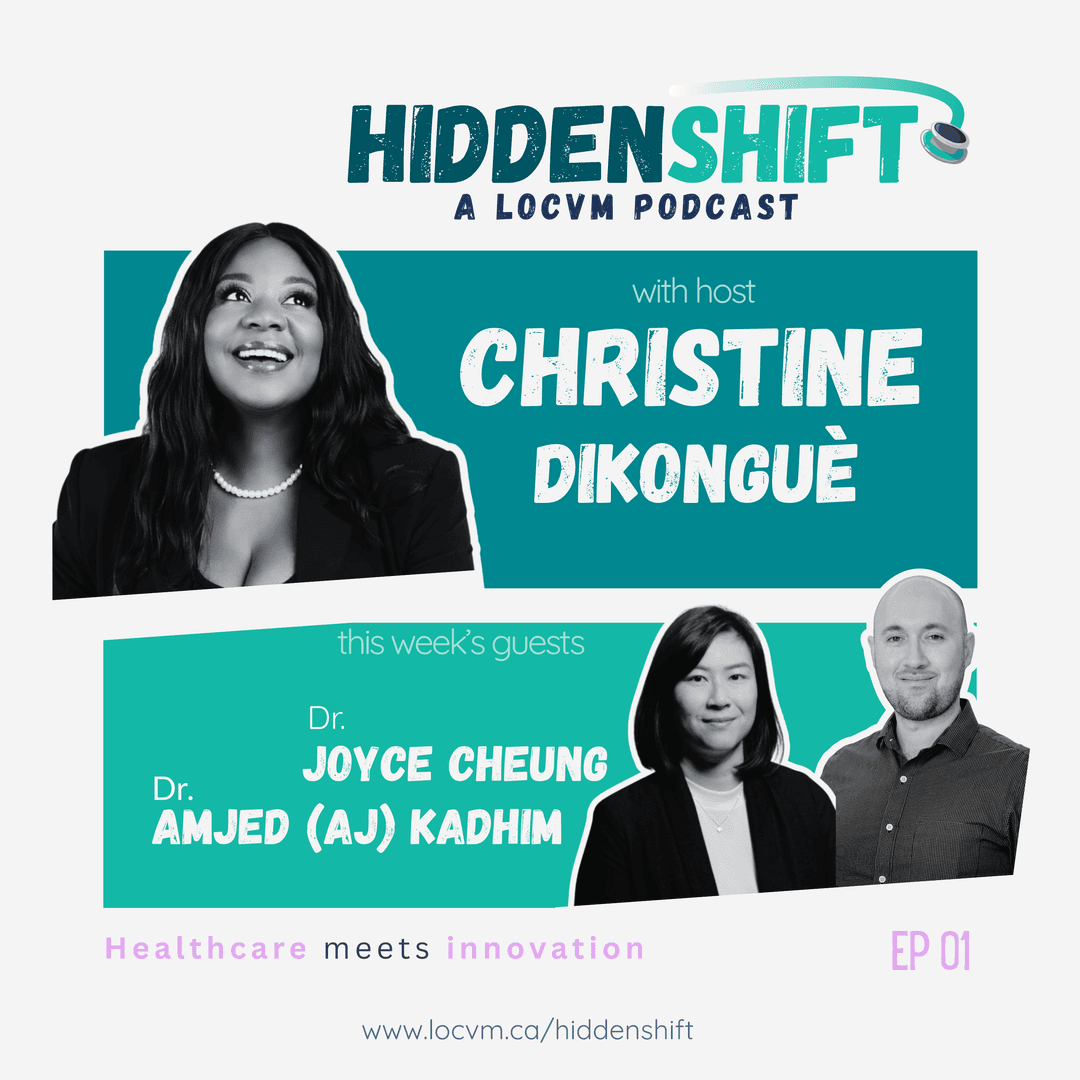
Dr. Chung was speaking on The Hidden Shift, LOCVM's podcast series on the structural pressures facing Canadian physicians. Alongside her was Dr. AJ Kadhim, a comprehensive family physician who owns and operates Vivo Family Medicine in Toronto, which serves over 5,500 patients. Together, they described a workday that routinely extends beyond its nominal end — not because of unusual circumstances, but because of the way the system is currently structured.
The volume problem
The administrative burden in Canadian primary care is not new, and it is not small. Research cited in the conversation estimates that family physicians spend between 10 and 19 hours per week on paperwork — time that, for many, comes out of evenings and weekends rather than clinical hours.
“I was spending a third of my time doing paperwork. That was eating away at my evenings, my weekends. I have two kids at home. So it was cutting into bedtime, getting home in time to actually see my kids.”
The sources of that burden are familiar to anyone practising in Canadian primary care: an inbox that receives labs, imaging, specialist notes, pharmacy requests, and patient messages continuously; fax machines that remain the dominant communication infrastructure between clinical settings; and documentation standards that require detailed charting of every encounter. Dr. Kadhim noted that sending a single specialist referral involves at least seven discrete steps in current EMR workflows. He sends approximately thirty a week.
"It just felt wrong to spend that much time on paperwork," he said.
Tools that don't fit the workflow
The conversation turned, naturally, to technology. There is no shortage of health tech companies trying to address the administrative burden in primary care — charting tools, AI scribes, referral management platforms, and patient messaging systems. The question is whether they are solving the right problems, and whether they are built by people who understand the problems they are trying to solve.
Dr. Cheung was direct about the gap. "You do have people that are building, and they don't understand the physician landscape," she said. "We see the real gaps in our work day and how our technologies would make a difference."
Dr. Kadhim echoed this as the motivation behind building his own tool, Pippen AI. "One of my fears when I was initially thinking about solving this is that if I just leave this to people who don't understand our workflows, there's going to be solutions, but those solutions may not work for us."
The concern is not abstract. Dr. Chung cited the impending shutdown of Prescribe It, an electronic prescribing tool that allowed physicians to send prescriptions directly to pharmacies rather than by fax. Despite demonstrably solving a real problem, the platform is closing because neither the government nor individual physicians and pharmacists have been willing to absorb the cost. The result, she noted, is regression: "We're going to be more entrenched in faxing."
The coverage problem no tool has solved
One administrative burden that AI scribes and charting tools do not address is the challenge of finding physician coverage. This is the problem LOCVM was built to solve, and Dr. Chung, who serves as LOCVM's Chief Medical Officer, described the gap in plain terms.
“Teachers have substitute teachers. They have a system in place. Doctors, we do not have that infrastructure.”
The consequences of that absence are well-documented in the research literature on early-career practice choices and physician burnout. Physicians who cannot find locum coverage when they need time away face a binary choice: stay and risk their health and well-being, or leave and risk their patients losing access to care.
Dr. Kadhim described knowing colleagues who had permanently closed their practices because coverage fell through at a critical moment. "Thousands of people would lose access to their family doctor just because of that," he said.
For Dr. Cheung, the personal version of this problem came into focus when she and her partner began thinking about parental leave. The only available mechanisms were informal: phone a colleague, post in a Facebook group, search a job board. These are not systems. They are workarounds for the absence of a system. "Either we would not take the time that we need," she said. "And without that, you might sacrifice things within your family, your social life — and we're not able to achieve that work-life balance at all."
What the system would need to support
Both physicians described the administrative burden not as a problem of individual physician resilience, but as a structural feature of how Canadian primary care is organized. The research is consistent with this framing: the Mathews et al. (2024) qualitative study of 68 Canadian family physicians identified workload, payment model, and access to locum coverage as system-level variables that either amplified or buffered burnout during the pandemic. Individual wellness initiatives, the same study concluded, do not address structural drivers.
"We need to invest in Canadian entrepreneurs who understand the problem," Dr. Cheung said, "because they are passionate about their own lived experience and the problem they're trying to solve."
Dr. Kadhim framed the challenge as one of system readiness as much as tool availability. "For healthcare to work, you need the system to support a solution. You need innovation from people who actually work in that system."
The tools exist, or are being built. The builders, in several cases, are the physicians themselves. Whether the system moves quickly enough to support and sustain those tools — rather than letting them close for want of funding, as Prescribe It is closing now — is the more open question.
Source
Dr. Joyce Cheung is a family and palliative care physician in Toronto and Chief Medical Officer of LOCVM. Dr. AJ Kadhim is a family physician, owner of Vivo Family Medicine, and co-founder of Pippen AI. This article draws on their conversation with Christine Dikonguè for The Hidden Shift podcast.
References
Mathews M, Idrees S, Ryan D, et al. System-based interventions to address physician burnout: a qualitative study of Canadian family physicians' experiences during the COVID-19 pandemic. Int J Health Policy Manag. 2024;13:8166. doi:10.34172/ijhpm.8166